For the record, here's the travel itinerary and transit systems used:
- Day 1 - Rochester to New York (RTS Bus 50, Amtrak Empire Service, MTA Subway N/4)
- Day 2 - New York to Philadelphia (MTA Subway 4/R, Amtrak Keystone Service)
- Day 3 - Philadelphia (SEPTA Subway Broad/Market-Frankford Lines, SEPTA Subway-Surface Trolley 34)
- Day 4 - Philadelphia to Washington (SEPTA Subway Broad/Market-Frankford Lines, Amtrak Carolinian, Washington Metrorail Red/Green Lines)
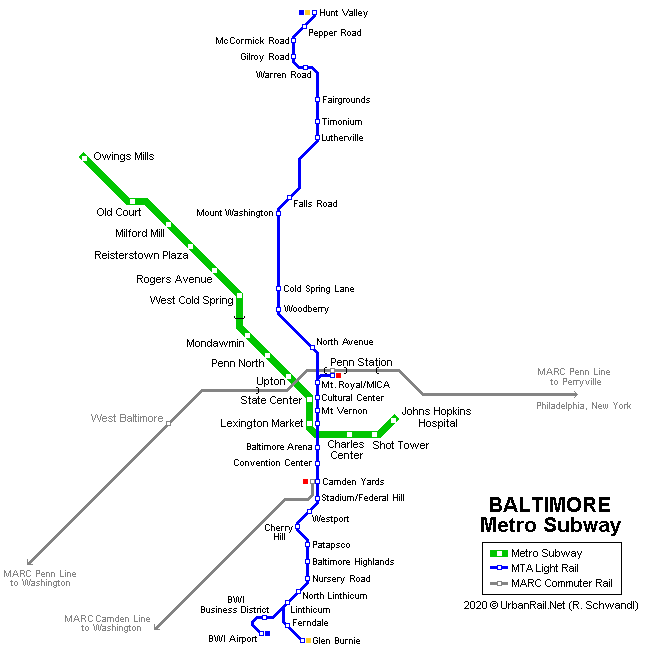
- Day 6 - Washington to Baltimore (Washington Metrorail Red/Green Lines, MARC Camden Line, Charm City Circulator)
- Day 7 - Baltimore to Rochester (Maryland Transit Administration Light Rail Blue Line, AirTran, RTS Buses 2/5)
What we liked: Brooklyn Heights, New York: Very quiet despite proximity to expressway due to cantilevered overhang (Brooklyn Heights Promenade)...superior italianate Hummelstown Brownstone architecture...Chip Shop on Atlantic's deep fried pizza, burger patty, and macaroni and cheese ball + Dry Blackthorn Cider on tap...Pete's Waterfront Ale House with Original Sin Cider on tap.
Upper East Side, Manhattan: Carl Schurz Park...Chicken Roll at Bagel Mill...reasonably human scaled urbanism, walkups 5 stories tall means less energy intensive going forward.
Amtrak, Northeast Corridor: Tracks owned by Amtrak themselves make for minimal delays...fast travel even on non-Acela trains between New York and Philadelphia. Center City, Philadelphia: Loads of cultural history lessons...Rittenhouse Square and other squares laid out by William Penn himself always teeming with life, properly programmed around their edges...Underground Transit Concourse integrates 3 systems and provides huge capacity to serve patrons at times of heavy ridership...extremely narrow carriageways still intact with high quality townhomes...Reading Terminal Market, the best public market we've ever been to(compared to By Ward - Ottawa, Broadway - Baltimore, St. Lawrence - Toronto, Rochester Public, Central New York Regional, Eastern - Washington)...Prevailing scale of urbanism due to pre-1985 'William Penn's hat agreement'...general affordability of goods/food compared to the others...small size of blocks promotes walkability (carried our luggage from 30th St to Broad/Locust).
 University City, Philadelphia: Amtrak's (Pennsylvania Railroad) 30th Street Station is simply magnificent. Well planned interior, integrated access to subway/trolley/commuter trains, dueling collonades reinforce importance of place and function, electro-mechanical departure board, seating in waiting area maximizes flow of foot traffic and proximity to gates...University of Pennsylvania campus massive, yet walkable, proximity to Rittenhouse Square.
South Philadelphia: Pat's King of Steaks, the original Philly Cheese Steak...9th Street quasi-arcaded Italian Market district, Anthony's Chocolate House's smore creation.
 Alexandria, Virginia: Much more newer building fabric integrated into the original design than I expected...Saltwater taffy at Candi's Candies at King and Fairfax...malt balls at The Sugar Cube on Lee...would have liked to take an affordable river cruise, but were preempted by charter...good scale, walkability, transit connections.
The District: Union Station, quality allegorical sculpture inside and out, functions as strictly massive rail terminal more like a contemporary airport in layout and commercial offering...new Nationals ballpark reasonably priced, quality views, accessible by foot and metrorail...Metro System well laid out and maintains high standard of cleanliness, headway notification a plus...Ben's Chili Bowl on U Street is legendary...Eastern Market and accompanying 8th Street SE restaurant district very vibrant...once again sights abound for historical buffs and Democratic-Republic fans.
 Fell's Point, Baltimore: Excellent preservation efforts retain townhomes tiny by today's standards...good restaurant base...connection to Water Taxi...large scale expansion/restoration of Broadway Market about to commence...streetcar track still extant in belgian block streets.
Harbor East, Baltimore: Excellent urbanist programming for community of exclusively newer construction...well integrated into the existing street grid...good mix of retail offerings, office space, residential space, services even if overly upscale.
There were a few experiences that were generally positive, but some subtext cast a dragnet that soured the place or service to some degree in our minds. Eastern Market almost fell into this category due to the loss of all other historic Washington D.C. markets (its size cannot possibly serve the entire district), comparison to the abundance of markets in Baltimore, and such dominant recent memory of Philadelphia Reading Terminal Market.
In contrast with Amtrak service along the Northeast Corridor, Amtrak service upstate continues to be plagued by issues related to leasing track from CSX and the lack of capacity on the old New York Central mainline. We were delayed for 45 minutes halfway between Rochester and Syracuse while a broken down freight was repaired and then moved out of the way. The trip was still more pleasant than driving to New York, but it made it that much longer.
 We've generally had a good time at Baltimore's Inner Harbor and I don't know if it was the rainy weather or what, but I've kind of soured on the mall-like pavilions on Light and Pratt Streets. It seemed as though more shopfronts were empty than usual, but I did get the preposterously good 'Crab Pretzel' from Phillips Seafood Express, a soft pretzel with a crab meat/cream cheese mixture integrated into the gaps with additional shredded cheese melted on top.
I am never against a light rail system, and Baltimore's seems to have stabilized Howard Street to a certain degree (compared to Park Avenue), but its greatest utility is shuttling business travelers to the airport. This is a feature I have utilized, but now feel there is little future for air travel. This sounds like a guilty conscious issue I need to deal with. At any rate, the light rail will continue to have utility in shuttling passengers between Penn Station and the downtown proper as more MARC trains at more times during the business day service the Penn line.
What we didn't like:
 I feel I owe more than sentence fragments if I am going to criticize. Let's start with Midtown Manhattan. Penn Station is our collective national disgrace as far as I am concerned (considering what came before the current incarnation). The low ceilinged bunker of a train station in the basement of a basketball arena is our national monument to the unenlightened behavior of the 1960's that rejected quality and ornament in favor of the space age. Difficult to enter, let alone navigate, or god forbid sit down, we certainly got "what it admires, will pay for, and, ultimately, deserves." Another criticism of Midtown is the dehumanizing scale. Each avenue forms a canyon of hypertrophic urbanism, not necessarily poor programmed, but tremendously energy intensive (though not per capita), and impossible to operate/renovate without reliable energy inputs unlike the neighborhoods described earlier.
We had flown AirTran Airways a number of times, but never remembered being as cramped as we were on the 717 aircraft for our return home. Add to this the $15 checked bag fee, dehumanizing security procedures, interminable waiting periods, the inefficiency and pollutants per passenger mile inherent in jet fuel, and I can't imagine we'll ever voluntarily board a domestic plane again.
While its obvious that Philadelphia knocked our socks off, we were greatly disappointed in Penn's Landing on the Delaware. Created in a time that truly believed people would frequent an amphitheater made of poured concrete steps at extraneous and haphazard geometries, Penn's Landing is impersonal, overly caters to automobiling, and is isolated by the I-95 freeway. Honorable mention goes to Geno's obnoxious cheesesteaks across the street from Pat's who refuse to serve non-English speakers and sell the tired trope 'Freedom Fries.'
While the Washington Metrorail System itself was a big positive, the administration of fares is completely asinine. Unlike New York, where once one fills a Metrocard with money, it functions as a debit card regardless of who uses it, in Washington each person must carry their own card. A zonal system makes fares variable depending on which two stations you intend on travelling between. The situation is compounded by incorrect signage at stations which do not always reflect price increases. As such, fare is actually debited from the pass upon exit from the system, necessitating 'exit fare' machines to add additional money to your card. What does one do who doesn't have any additional cash? Are they doomed to ride the rails forever? The entire scenario gives the classic American heartland impression of 'Washington' making something overcomplicated in their efforts to do the opposite. In terms of daily and weekly passes, one can purchase weekly bus passes and daily rail passes, neither of which let you use the other mode of service.
 The emerging Navy Yard neighborhood in Washington is falling into a trap in my estimation. While generally pleasing condo and apartment towers are going up, they are doing absolutely nothing at ground level for the pedestrian (in fact, the ground floor at Capitol Yards includes a security desk where we were forced to show official identification to be put on a visitor log). There doesn't seem to be a coherent plan to introduce retail as was done expertly in Baltimore's Harbor East mentioned above. The result is an impersonal neighborhood that is not only car dependent, but largely encourages car ownership through the ease of underground parking below each building.
Walking around a larger portion of Downtown Baltimore than usual, I noticed a pair of stunning trends. The first is that every single attraction in Baltimore, right down to Lexington Market, must have a sizable parking garage attached to the building. I don't have to say what this portends for street life, but the existence of the arrangement reeks of suburban fear of race and class. Baltimore, moreso than other places, has created surface level pedestrian impediments. President, Light, Lower Howard, MLK Jr, and Russell Streets all function as multi-lane (greater than 4) car movers that dissect downtown areas and add danger to pedestrian activity. A system of 2nd floor open-air walkways designed to connect Inner Harbor shopping with downtown hotels (though not advertised anywhere anymore) also diverts pedestrian life from the street, though Baltimore has begun removing some of these sections. One final minor gripe involves the B&O Railroad Museum not being open at 3PM despite posted hours until 4PM. It's my understanding there is an inclement weather policy. Seems that Baltimoreans are not a hearty bunch. I'll bet the place was a madhouse during the March snowstorms.
And there you have it. Not much of a restful vacation, but that's just how it goes with us. On deck for the blog is a comparison of Scranton's 500 Lackawanna project to possibilities for the Renaissance Square block, more RIT downtown campus history, and of course the John Robert Smith meeting and lecture. All of this can and probably will be preempted by any big breaking urban development news, but stay tuned. Oh, and thanks to you, the reader, for an improvement in April traffic of 76% compared with April 2009!